Air Control in Sewage and Wastewater Applications — Your Questions Answered
In a recent BERMAD webinar, “Air Control in Sewage & Wastewater Applications,” Eyal Geller, our Air Valves Product Manager, shared some insights regarding the use of air valves in sewage and wastewater applications.
In a recent BERMAD webinar, “Air Control in Sewage & Wastewater Applications,” Eyal Geller, our Air Valves Product Manager, shared some insights regarding the use of air valves in sewage and wastewater applications.
During the webinar, questions about the use of air valves in sewage and wastewater systems, as well as considerations for selecting, installing, operating, and maintaining air valves, were addressed:
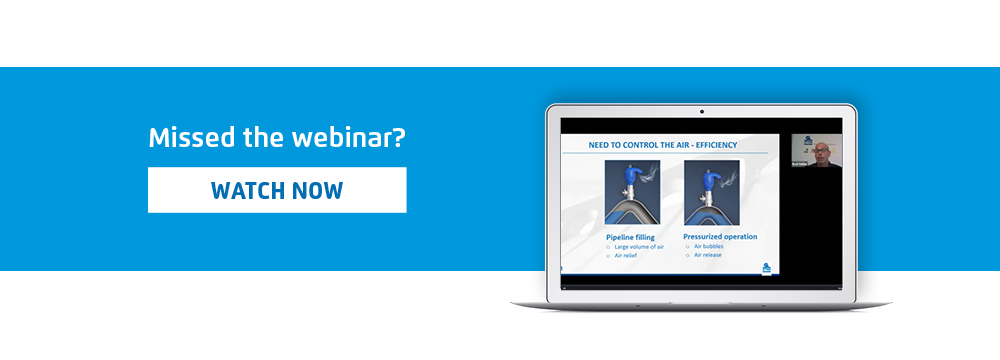
Air valves are essential for efficient operation during pipeline filling and pressurized operation, as well as for protection against vacuum conditions during draining or in cases of water hammer and surge pressure. They are installed at pumping stations, along pressurized collection pipelines, and in wastewater treatment plants. Air valves used in sewage and wastewater applications must handle grease, fats, suspended and dissolved solids, and other foreign objects that enter the sewage system. Because sewage and wastewater air valves are engineered products, their selection should be based on factors such as performance, size, and their placement within the system.
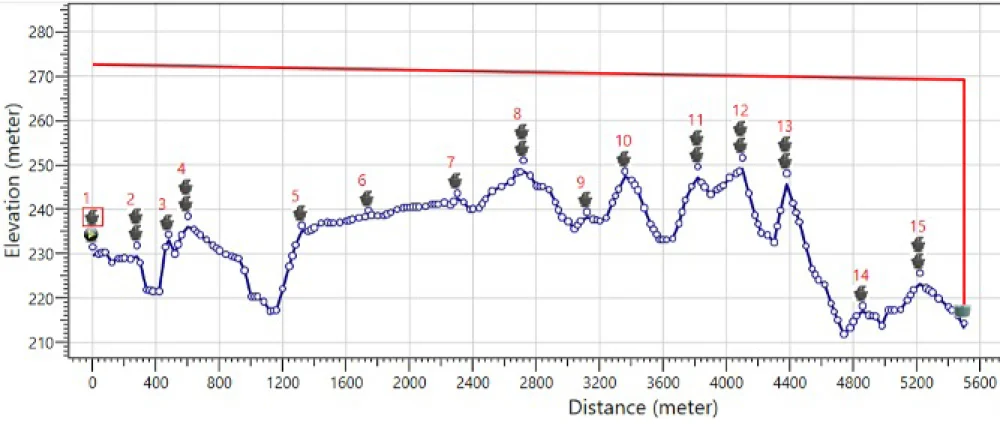
BERMAD’s application engineering approach is to evaluate the volume of air which needs to be controlled and then to select the air valves which comply with the required air flow capacity. To ensure design optimization, valve selection should be undertaken using common formulas or specialized software such as BERMAD AIR. In some cases, recommendations from surge analysis software must be used. While a rule of thumb can be used to estimate the preliminary estimation, it cannot replace the above approach. In addition to common specifications for air valve (type, construction, pressure rating and inlet connection) it is important to specify the required air flow capacity. This will ensure that the installed air valve has an air flow capacity that complies with design.
BERMAD AIR – Air Valve’s sizing and positioning software
Air valves are not required in gravity systems where the pipeline is not pressurized, such as when the flow is at a partial cross-section (for example, in a tunnel). These types of unpressurized gravity lines are typical at the start of a domestic sewage network, where fluid is collected from households and conveyed to an intermediate pumping station or tank. In gravity lines where the pipeline is pressurized, such as when sewage is delivered from a mountain to a treatment plant in a valley, air valves must be considered. One of the main objectives in these systems is to prevent vacuum conditions during draining.
Combination air valves should be considered at the beginning and end of long horizontal sections, and automatic air valves (or combination) should be considered at intervals of 1/4-1/2 mile; 400-800m along horizontal sections of pipelines.
BERMAD’s application engineers are at your service for engineering reviews of project designs and operations. They will support you in defining the air control requirements and will provide engineering recommendations, based on sizing & positioning and surge analysis software.
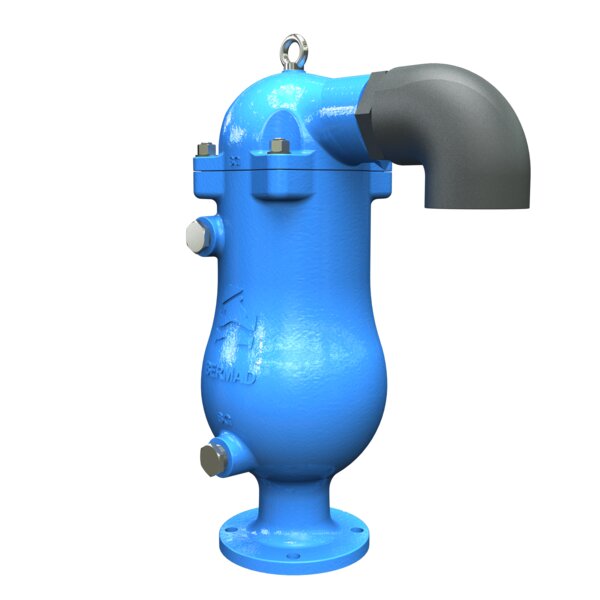
When connecting an air valve to a drainage pipeline, it is important to use a drainage pipeline that has the same diameter as the valve outlet. The surge protection feature is recommended to address risks of surge pressures caused by pump operation in pulses (sometimes several cycles of start-up and shut-off within one hour). It will also help prevent grease and solids from reaching the upper mechanism. Since the system pressure is relatively low and the pipeline is flat, an air valve with low pressure sealing of 0.8 psi; 0.05 bar will prevent leakage. It’s important to look for air valves that are easy to maintain—lightweight, top opening to allow the internal assembly to be pulled up for quick replacement, back flush option, and 100% corrosion resistance. Following these guidelines will enable longer periods of maintenance-free operation and reduce costs.
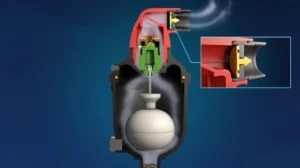
Cutaway of BERMAD C50 with Surge Protection feature
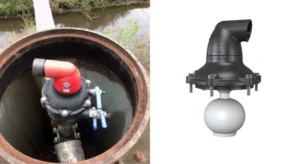
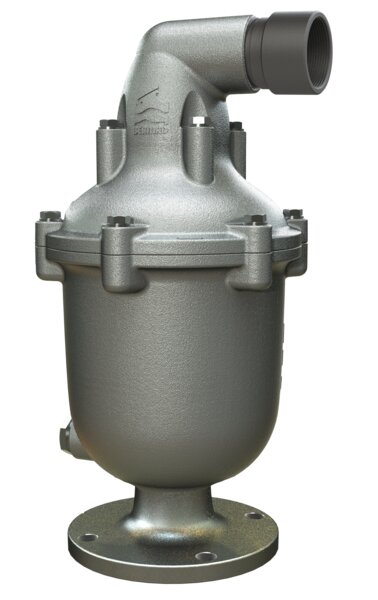
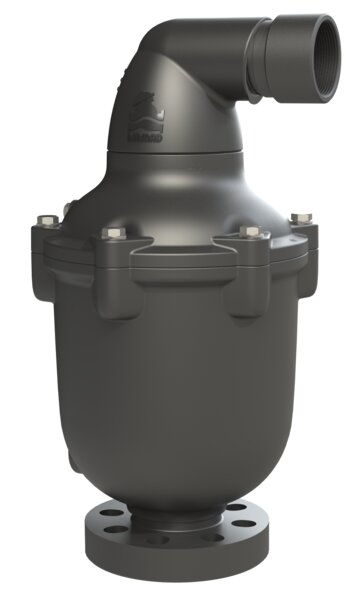
BERMAD C50 can be opened from the top, enabling the internal assembly to be pulled up for quick replacement or service
BERMAD’s C50 is designed to prevent water spitting at the end of pump startup or during automatic air release. Additionally, the valve’s low-pressure sealing is 0.05 bar, which helps prevent leakage.
Watch the animation of BERMAD C50 principles of operation
https://youtu.be/j1elNkw-zrs
A strainer connected beneath the air valve inlet can also get clogged. In addition, the strainer will limit the air flow capacity. It is best to select an air valve able to cope with suspended solids, grease, and fats.