




Emergency Valves for Pressure Control Systems in High Rise Buildings
Emergency Valves for Pressure Control Systems in High Rise Buildings
Did You Update BERMAD Connect Already? Check It Out
Update BERMAD Connect Today! Check It Out




In a recent BERMAD webinar, “How to Design & Implement a Pressure Reducing Station for Extreme Pressure Difference,” Nimrod Shafir, our Building & Construction Application Engineer, discussed the challenges of designing and implementing water supply systems in high-rise buildings to ensure reliable water supply and stable pressure to all levels at all times.
<img id="hs-cta-img-33dd6da3-0b77-4b8f-a956-28daeb1446c6" class="hs-cta-img" style="border-width: 0px;width:auto;display:inline-block;" src="https://www.bermad.com/wp-content/uploads/2020/06/33dd6da3-0b77-4b8f-a956-28daeb1446c6.png" alt="<>”> hbspt.cta._relativeUrls=true;hbspt.cta.load(2377786, ’33dd6da3-0b77-4b8f-a956-28daeb1446c6′, {“useNewLoader”:”true”,”region”:”na1″});
During the webinar, questions regarding energy consumption, cavitation ratios, and placement of pressure reducing valves (PRV) were addressed:
Q: Is it true that using a PRV will result in high energy consumption? Can you suggest another energy-saving solution?
A: It’s true that using a pump to add potential energy to the water and then reducing it is wasteful; it can be described like driving a car at full throttle while controlling the speed with the brakes. Pump manufacturers advise installing a VSD pump for each of the pressure zones. While using VSD pumps is an energy-saving solution, it’s also a more complex solution than using PRVs, which can prove to be a problem during the operation and maintenance stage of the project.
Q: Does a PRV work in static conditions?
A: When there is no consumption and no flow, the PRV will tightly close the seal, preventing the high inlet pressure from passing to the downstream.
Q: Is the bottom feed only to reduce the cavitation ratio?
A: Yes, from the point of view of the valve’s position, using a bottom feed is an elegant way to protect it from cavitation or noise problems.
Q: Can we use a piloted PRV as the first stage and another piloted PRV for the second stage, setting them at ratios lower than 2.5:1 to further avoid noise?
A: Using two piloted PRVs in succession is not recommended because it may cause oscillation between them. If using the proportional PRV at a 2.5:1 ratio is not a viable option, consider using a bottom feed design.
Q: Why is a 2.5:1 ratio always used in proportional pressure reducing valves instead of a 3:1 ratio?
A: First, the ratio of 3:1 is too close to the point where cavitation and noise occur, and we’d like to keep a margin.
Second, if the total reduction required for the overhaul (across both stages) is just over 3, then using a proportional PRV with a 3:1 ratio will not leave enough pressure for the next stage to operate.
Q: Is any distance required between a proportional PRV and a pilot-operated PRV?
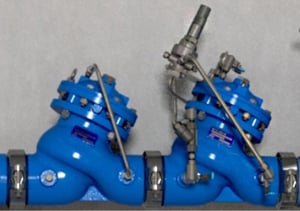
A: There is no minimum distance required between the valves. As shown in the photo below, they are connected to each other. This setup saves valuable space in building installations.
Q: When pressure is reduced from 10 to 4 bar (for example), you have a peak of low pressure. How do we know this value doesn’t exceed the cavitation value?
A: The simple solution is to keep the PRV operating at a ratio below 3:1. The slightly more complex solution is to maintain the value Pmin above the vapor pressure of water (0.02 bar absolute):
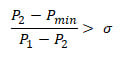
Where σ is a value of the valve (in most Globe valves σ≈0.5) and all pressures are absolute.
For more complex calculations, prediction of valve lifetime under cavitation conditions, and estimation of noise levels, we use our dedicated BERMAD Sizing program.
One of the biggest challenges in designing and implementing water supply systems in high-rise buildings is ensuring a reliable water supply and stable pressure to all levels at all times. In this webinar, we will discuss how to overcome this challenge by efficiently distributing pressure zones in high-rise buildings. Additionally, we will examine different types of pressure reducing systems and valves, and how to install them correctly for optimal results.
hbspt.cta._relativeUrls=true;hbspt.cta.load(2377786, ‘5899a857-e898-4889-abe0-00fc925f9322’, {“useNewLoader”:”true”,”region”:”na1″});




We got your email. Now, let’s make it personal...