


The UK Leakage Challenge: Why Smarter Pressure Management Is Becoming Essential
Did You Update BERMAD Connect Already? Check It Out
Update BERMAD Connect Today! Check It Out




Water distribution in high-rise buildings presents a unique hydraulic challenge: how to supply water reliably to dozens of floors while maintaining stable, acceptable pressure at every point of use.
As buildings grow taller, traditional and intuitive design approaches are often pushed beyond their practical limits, in some cases with costly consequences.
This article discusses a common pressure reducing design used in high-rise buildings, explains why it frequently fails in modern tall structures, and presents a proven, stable alternative that is widely recommended in modern design.
In many high-rise buildings, water is pumped to roof level tanks or intermediate storage tanks located on technical floors. From there, water is supplied downward by gravity through a vertical pipe known as the downfeed riser.
Floors located up to approx. 20–25 meters below the tank can’t be served by gravity alone and requires booster systems. Below this zone, gravity pressure is sufficient and increases with the elevation drop.
As water flows downward, pressure rises proportionally. Without control, lower floors would be exposed to excessive pressures, exceeding acceptable limits for plumbing fixtures and fittings.
Typical design criteria aim at:
Therefore, it is necessary to reduce pressure.
A common concept is to install pressure reducing valve (PRV) stations directly on the downfeed riser. When water pressure reaches the maximum allowable value, a PRV station is set to reduce it back to the minimum required level. As pressure builds again further down, additional PRV stations are installed in series.
This configuration is known as a cascade PRV system.
In the past, when buildings were relatively modest in height, a single PRV station was often sufficient, and the cascade approach worked reasonably well. Today, modern, taller buildings, require multiple PRV stations, creating a fundamentally different hydraulic situation.
Extensive field experience has demonstrated that cascade PRV systems, in which multiple valves are installed in series, are inherently unstable in tall buildings.
Each PRV directly influences the inlet pressure of the next valve downstream. As a result, the individual control loops interact with one another, responding dynamically and often amplifying pressure and flow fluctuations instead of stabilizing them.
Common symptoms include:
These issues are widely documented in real installations and often require costly corrective actions.
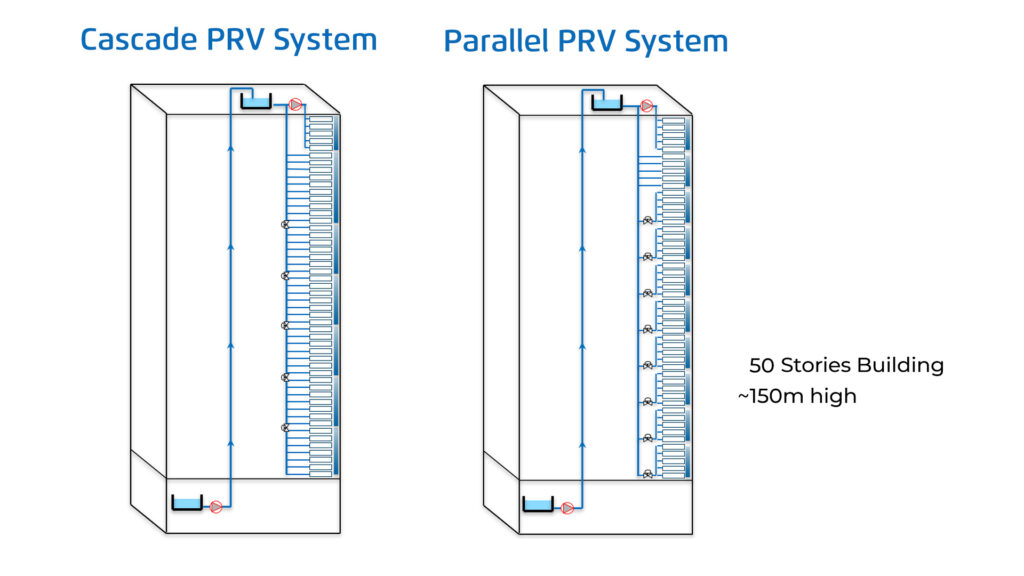
A stable and reliable design maintains a clean and uninterrupted downfeed riser.
Instead, the best and proven practice in modern high-rise design is to implement a Parallel PRV Zoning System, a.k.a. Zoned Pressure Reduction System.
In this approach:
Using this configuration, PRV stations branch off the main downfeed riser and operate independently, eliminating control interaction and ensuring stable, quiet, and reliable system performance.
While cascade PRV systems may appear intuitive and logical, they are unsuitable for modern high-rise buildings. Installing multiple pressure reducing valves in series along the downfeed riser inevitably leads to hydraulic instability, noise, and frequent operational failures. Such behavior is unacceptable in a residential or commercial building environment, where reliability, comfort, and long term performance are essential.
Meanwhile, a Parallel PRV Zoning System provides a stable, quiet, and reliable pressure reduction solution. By supplying each pressure zone independently, this approach eliminates control interaction and ensures consistent service conditions. As such, it is strongly recommended as best and proven practice for modern high-rise design.
Remember: once a water supply system is up and running, it is practically impossible to reconfigure it. Proper planning must therefore be addressed at the earliest design stages. BERMAD offers support to designers and consultants throughout the design phase, contact our experts for further information and assistance.

We got your email. Now, let’s make it personal...