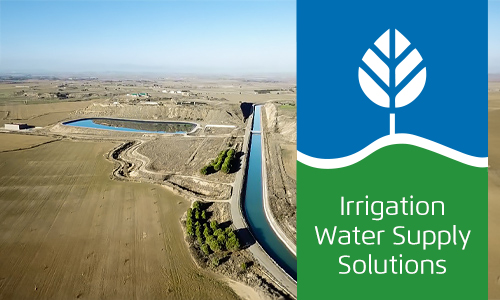
Water delivery networks must be designed for low maintenance, with built-in protection against hydraulic events such as pressure surges, pipe bursts, water hammer, and leaks. These unwanted occurrences, especially when combined with poor design and low-quality products, can cause significant damage and high costs. BERMAD’s solutions ensure efficient system performance, optimal air control, pressure and flow regulation, and are supported by comprehensive digital capabilities that provide highly accurate flow metering, remote management, and real-time alerts.
In our latest webinar we introduced BERMAD’s offering for water distribution networks, and discussed practical installations worldwide.
In this recording you will find practical engineering approaches to:
Regulating pressure and flow along the distribution lines
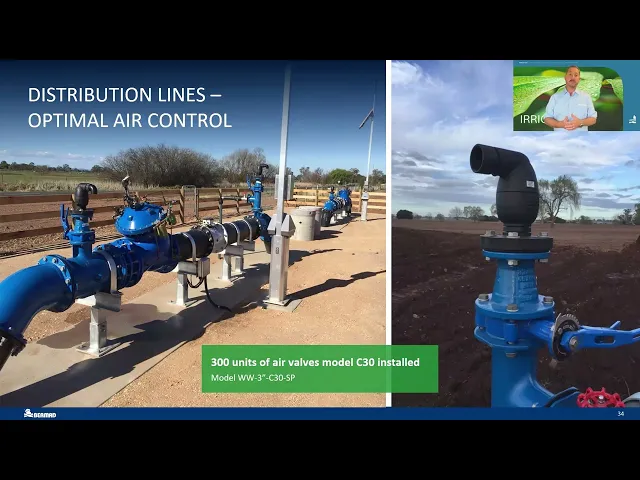
Optimal air control
Prevent, water hammer and other unwanted hydraulic events
Accurate flow metering for reliable system operation, monitoring and optimization
Enabling system remote control and real-time monitoring for immediate reaction to any system event
During the webinar questions were raised. Here are the issues we addressed:
A quick pressure relief valve can be properly sized by considering both its role as a safety control valve and the specific hydraulic conditions of the system it is protecting.
A quick pressure relief valve is a hydraulically operated control valve installed branched, offline to the main pipeline. It continuously senses mainline pressure. When pressure rises and reaches the calibrated set point, the valve opens immediately and relieves excessive line pressure, protecting the pipeline and system components from excessive pressure & water hammer.
The quick pressure relief valve can be sized using two approaches:
Conservative sizing approach:
Size the valve to be able to relieve the full system flow. This simplified, robust method provides maximum protection against sudden pressure spikes and a high safety margin for the pipeline.
Optimized, cost-effective sizing approach:
For a more economical and accurate solution, size the valve using BERMAD’s sizing software. The software considers key parameters such as system flow rate, main pipe diameter, pipeline pressure rating (PN), relief pilot set point and downstream pressure, enabling precise sizing without unnecessary oversizing and water losses.
As a quick pressure relief valve is a safety valve that typically operates only during short events (often for just a few minutes per day), higher design flow velocities are acceptable. In practice, velocities of up to 15 m/s are commonly used when sizing WW-73Q quick pressure relief valves, enabling compact valve selection while maintaining reliable protection and long-term pipeline integrity.
Yes. BERMAD offers two models of electromagnetic, non-moving-parts flow meters designed for flow metering needs of the distribution network:
MUT 2200 – Available from 1 in. to 80 in. (DN25–DN2000). Requires 5 DN upstream and 3 DN downstream straight pipe lengths to ensure optimal accuracy, making it ideal for large pipelines and main networks.
MUT 2300 – Available from 2 in. to 12 in. (DN50-DN300). With no straight pipe requirements (0 DN) upstream or downstream, it enables accurate metering in compact or confined installations.
Both models provide high accuracy, require virtually no maintenance, are MID-certified for water billing, and are suitable for dirty irrigation water—ensuring reliable performance across a wide range of applications.
BERMAD Sizing and BERMAD Air are advanced engineering software tools that support optimal system design by guiding engineers to the most suitable valve models and sizes, improving performance, reliability, and cost efficiency.
BERMAD Sizing goes beyond standard sizing guidelines by using proprietary BERMAD formulas that account for real-world hydraulic factors such as cavitation, valve travel, flow velocity, noise, and operating conditions. The result is recommendation for optimal valve selection that supports stable operation, long-term performance of the valve & the system and optimized system efficiency.
BERMAD Air is a design tool for air control in water systems. It helps engineers select the appropriate air valve type, size, and location along the pipeline to prevent water hammer, vacuum conditions & pipe collapse during burst & drainage, as well as ensure efficient air release during pipeline fill-up & pressurized operation, therefore, extending system lifespan, and minimizing overall costs.
Both tools are available on the BERMAD Global website (Resources → Tools):
BERMAD supports engineers and water utilities with professional surge analysis services designed to ensure safe, reliable, and resilient hydraulic system operation. Using advanced water transient analysis software, BERMAD helps identify and mitigate both positive and negative surge events, for worst-case scenarios such as power failures and sudden pump stoppages.
Using leading simulation tools such as KYPIPE (or other locally approved software used by BERMAD subsidiaries), engineers receive a comprehensive surge analysis report tailored to their system. The report presents system pressure behavior under steady-state conditions, during surge events without protection and with the recommended protection strategies and solutions, to support optimized design and effective surge protection.
Backed by BERMAD’s 60 years of experience, these services help reduce risk, protect infrastructure, and ensure long-term, stable system performance.
The Epsilon is available in two versions: Epsilon-DL and Epsilon-C.
Epsilon-DL is an advanced data logger for network monitoring and system analysis. It supports Digital Twin implementations to optimize system operation and improve service levels.
Epsilon-C is an advanced controller for pressure management and water supply control, supporting:
Two pressure regimes (Low/High) based on flow rate or time windows (Day/Night)
Monitoring and data logging at critical DMA points to support pressure management
Flow rate and totalized volume measurement to support water balance calculations
Both versions are remotely managed devices that securely log the data from different sensors and transmit it to a user-friendly cloud platform using cyber-secure communication.
Both models can operate on battery power and/or external power, enabling flexible installation at remote sites as well as at fully powered network control locations.
A pressure reducing valve (PRV) lowers higher upstream pressure to a lower, constant, and adjustable downstream pressure, regardless of changes in demand or upstream supply pressure. This is true in both dynamic and static (no-flow) situations.
In static conditions, when downstream demand drops to zero, such as when an irrigation cycle ends, the reducing pilot detects the increase in downstream pressure and moves the PRV toward the closed position. In a dead-end line, even if the valve is completely shut with no leaks, the downstream pressure may stabilize slightly above the set point due to pressure equalization and the characteristics of the pilot and valve—keeping the PRV closed until demand starts again. 720-X Product Page